
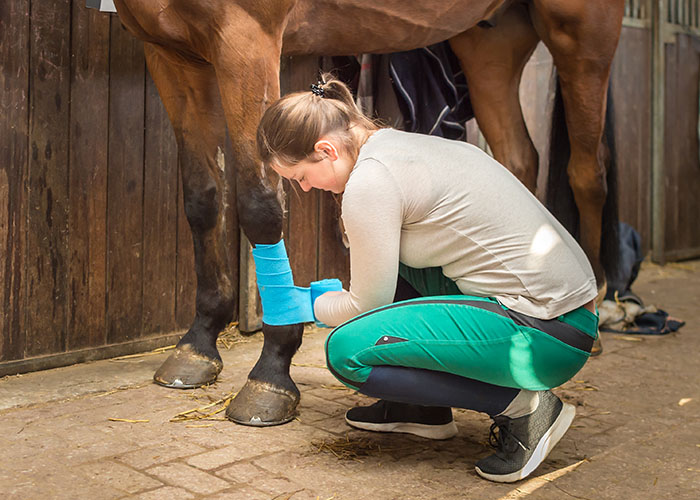
You have a lot riding on the health and wellness of your horse’s legs. In order to keep your horse’s legs sound and blemish-free, we often recommend to our customers that they utilize boots or wraps when they are riding or trailering their horse, as well as during turnout. There are a number of different styles of wraps and horse boots, each designed with a specific purpose in mind. In this blog post, we explore the various types of equine leg protection and help you select which type(s) would be most appropriate for your horse.
Leg Wraps
Polo Wraps: Perhaps the most widely-known form of leg protection, polo wraps gently support your horse’s leg and hold the tendons and ligaments in proper alignment while being exercised. Polo wraps are used to help prevent injury when your horse is being ridden or during groundwork sessions. They also protect against dirt and debris, making them a popular choice when horses have cuts or abrasions on their lower legs. Polo wraps are available in a variety of sizes (lengths) and colors, allowing you to find a pair for every horse. They may be used on either the front or back legs, or both.
Pillow Wraps, Quilted Wraps, No-Bow Wraps, and Cotton: These thick wraps are designed to be worn underneath a stable wrap or stall wrap when your horse will be standing still or minimally moving (such as in a stall or in a trailer). This set-up of two wraps (a thick base wrap and a thinner exterior wrap) is known as a standing wrap. They provide support for the horse’s leg and help to minimize inflammation and swelling. Many equestrians use standing wraps after a strenuous workout or at a horse show to ensure that the horse’s legs do not swell overnight. They are recommended for use when your horse is recovering from a tendon or ligament injury. Generally, pillow wraps are thick, plush wraps, while quilted wraps are made from a thinner cotton material. No-bow wraps are typically made from a thin foam. Disposable cotton wraps can be used over an injury as a standing wrap to protect the wound from foriegn objects while absorbing any excess moisture.
Standing Wraps, Stall Wraps, and Flannel Wraps: Standing wraps (also known as Stall or Stable Wraps) are worn over your horse’s pillow wraps to hold them in place in a standing wrap configuration. It is important to fully understand the proper application of standing wraps over pillow wraps, since standing wraps have no stretch. They are typically made from a substantial double-knit polyester, which makes them supportive outer wraps. If the wraps are applied too tightly, they may damage the delicate structures of the horse’s leg or bow a tendon. Conversely, if the wraps are too loose they may slide down the horse’s leg and out of proper positioning. It is essential to use a padded wrap under these wraps to distribute pressure evenly and help avoid injury.
Track Wraps and Turf Knits:
Also known as Cold Water Bandages, these stretchy knitted wraps are very popular for race horses. They can be soaked in ice cold water prior to wrapping to provide soothing, cold relief directly to hot legs after a strenuous workout.
Quick Wraps: Quick wraps, like the Back on Track Quick Leg Wrap and Cashel Boomer’s Bandages, combine the support of standing wraps with the ease of use of a horse boot. Using an integrated wrap system, they take the guesswork out of properly applying standing wraps. They are used to support your horse’s legs, reduce inflammation, and/or protect an open superficial wound.
Elastic Exercise Bandages: Elastic wraps, like the Lami-Cell Elastic Exercise Bandages, provide the support of a polo wrap with a convenient non-slip lining which helps to keep them properly positioned. Additionally, due to their lower profile they do not absorb water, which makes them popular for use in wet conditions. Because of their elasticity, it is recommended that you use additional care during application, since they are very easy to apply too tightly and cause damage to your horse’s tendons and ligaments.
Horse Boots
Bell Boots/Overreach Boots: Frequently made of durable rubber or a tough denier nylon fabric, bell boots protect your horse’s coronary band, pastern, hooves, and the bulbs of the heels from the impact of your horse’s other hooves. They are a popular choice for horses who overreach and have a tendency to pull shoes or injure themselves; typically they are worn on the front hooves. Bell boots come in two main styles, pull-on rubber boots and hook-and-loop boots; generally the pull-on boots are more difficult to put on and take off.
Fetlock Boots/Ankle Boots: Fetlock boots are worn on your horse’s hind legs to protect from interference, particularly when horses need to make tight turns or are generally narrow behind. Typically they feature reinforced padding on the fetlocks to minimize the chance of injury. Many hunter/jumper and event riders choose to use fetlock boots as an additional safety precaution when they are working over fences.
Hind Boots: Similar to fetlock boots, hind boots protect your horse’s hind legs from the effects of interference. Unlike their shorter counterparts, they extend up the horse’s cannon bone for additional impact resistance. They can also be used for turnout if you have a rowdy or accident-prone horse. Some hind boots, like the EquiFit MultiTeq Hind Boot, feature a memory foam lining for a practically custom fit.
Hock Boots: These specialized boots are designed to be worn over your horse’s complex hock joint. They often feature an opening at the point of the hock for comfort and to allow for a full range of motion. Generally, hock boots are not worn when you are riding your horse; instead, they are typically worn when your horse is in their stall to prevent hock sores and abrasions or during transportation as an added layer of protection. They may also be used in lieu of bandaging your horse’s hocks in the event of an injury. For horses who do not tolerate traditional hock boots or if you live in a warm climate, hock shields, such as the Intrepid Click Hock Shield, allow for more air circulation to keep your horse comfortable and protect against hock sores.
Open Front Boots: When jumping your horse, you want to protect the delicate tendons of your horse’s leg, yet still allow your horse to feel if they hit the jumps or cavellettis. Open front boots are worn on your horse’s front legs and leave the front of your horse’s cannon bones and pasterns exposed, while they cover the tendons and ligaments. Some boots, like the Woof Wear Smart Tendon Boot, feature reinforced plates in the “strike zone” for additional defense against the hind limbs. Many hunter/jumper and eventing riders choose to use open front boots (also known as tendon boots).
Sports Medicine Boots: Sports Medicine Boots (also known as performance boots and support boots) feature an adjustable strap underneath the fetlock, sometimes referred to as a suspensory strap. This unique design element supports your horse’s tendons and ligaments, while minimizing the chance that that overextend. They also protect the leg from impact. SMBs are commonly used by Western performance riders, such as reiners, cutters, and gymkhana riders. We carry support boots for your horse’s front and hind legs.
Shipping Boots: Designed to be used when transporting your horse, shipping boots protect your horse’s lower limbs from the coronary band, over the cannon bone and tendons, all the way to the knee or hock. Extremely easy to put on and take off, they are used exclusively when your horse is on trailer. Most of the shipping boots that we carry, like the Horseware Amigo Travel Boots, feature a fleece lining for comfort and a tough denier exterior for the utmost protection.
Splint Boots/Brushing Boots: Splint boots are built with reinforced padding over the inside of your horse’s leg which protects against interference and injury to the splint bone. Typically, they are used for light riding, turnout, and groundwork. They are also extremely easy to put on your horse’s leg, making them popular for use in lesson barns and with beginner equestrians. These versatile boots come in a wide variety of sizes and may be used on either the front or back legs.
Therapy Boots: Most of the styles of boots that we carry can be purchased in specialized therapeutic materials. These innovative fabrics help to increase blood flow to the area which promotes healing and decreases inflammation. Horses with a history of soft tissue injuries, weak tendons, or arthritis are often prime candidates for therapeutic boots. Some of the more popular therapeutic boots that we carry come from Back on Track, such as the Back on Track Royal Work Boots, which feature the patented Welltex technology and may have beneficial effects on tissue and cell stimulation.
Tips for Application
How boots and wraps fit your horse is just as important as the leg protection that they are wearing. It is essential that you select the proper size as well as apply the wraps or boots correctly. When shopping for wraps and boots, take your horse’s size as well as the thickness of their legs into consideration. Generally, these protective leg products are available in pony sizes (sometimes even miniature horse sizing) through oversized and draft horse sizing.
If the wraps or boots fall down or fall off, they can be a tripping hazard and may injure your horse. Conversely, a wrap or boot that is too tight will cause additional pain and inflammation, and may possibly cause damage to the tendons. It is important that leg protection is snug, but not so tight that you cannot slip a finger between your horse’s leg and the boot or wrap.
The direction of the velcro or buckles is extremely important as well. They should always close toward the back of your horse’s leg. This minimizes the pressure across the tendons of the leg, while making it more difficult for the fasteners to come undone.
Wrapping your horse’s leg requires an educated feeling as to how much pressure you should apply. The best way to learn how to wrap a leg is under the guidance of an experienced equestrian. This video also includes some great tips on how to properly wrap your horse’s leg.
When it comes to selecting a set of boots or wraps for your horse, you have many options to choose from. Our friendly and highly trained sales staff can assist you in choosing the best wraps and boots for your horse, based on their size, conformation, fitness level, discipline, and individual requirements. We encourage you to reach out to us so we can help you evaluate your horse’s needs.
